You’ve picked the perfect diamond.
You’ve decided between natural and lab-grown.
And then the jeweller asks: “9K, 14K, 18K, or 22K?”
Suddenly you’re stuck. Most people know gold purity matters—they just don’t know why, or which one is actually right for their piece. This gold karat guide breaks down 9K, 14K, 18K, and 22K gold in plain, simple terms, so you never have to just nod and hope you picked right.
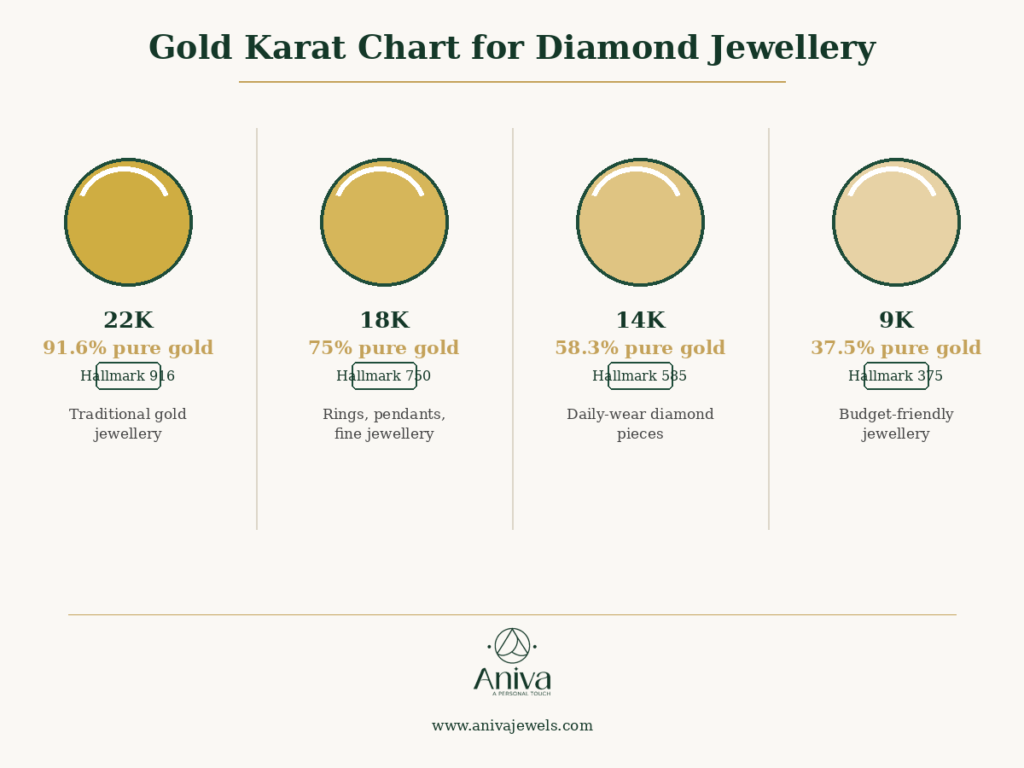
Quick Gold Karat Chart (India)
| Karat | Purity | Hallmark Stamp | Best For |
|---|---|---|---|
| 24K | 99.9% pure gold | 999 | Coins, bars (not jewellery) |
| 22K | 91.6% pure gold | 916 | Traditional gold jewellery |
| 18K | 75% pure gold | 750 | Diamond rings, pendants, fine jewellery |
| 14K | 58.3% pure gold | 585 | Daily-wear diamond jewellery |
| 9K | 37.5% pure gold | 375 | Budget-friendly diamond jewellery |
Bookmark this gold karat chart—it answers most of what people search for before they even ask a jeweller.
What Does “Karat” Actually Mean?
Karat (K) tells you how much pure gold is in your jewellery—out of 24 parts.
- 24K → 100% pure gold (too soft for daily jewellery)
- 22K → 91.6% pure gold
- 18K → 75% pure gold
- 14K → 58.3% pure gold
- 9K → 37.5% pure gold
The remaining percentage is made up of other metals like copper, silver, or zinc—called an alloy. This alloy is what gives gold its strength, since pure gold on its own is too soft to hold a diamond securely.
Why Pure Gold (24K) Isn’t Used for Diamond Jewellery
This surprises a lot of first-time buyers.
24K gold is beautiful, but it’s also soft enough to bend with regular wear. For a piece that has to grip a diamond in place—through daily movement, knocks, and years of wear—pure gold simply isn’t practical.
That’s why every piece of diamond jewellery you see is an alloyed gold, not pure gold. The question isn’t “should I go pure or not”—it’s “how much alloy is right for my piece.”
Step 1: Understand Each Karat, One by One
22K Gold
- Very high gold content, rich yellow color
- Softer, more prone to scratches
- Best for: Traditional gold jewellery, minimal or no stone-setting
- Not commonly used for diamond jewellery, as it’s too soft to hold stones securely
18K Gold — Best Gold Karat for Diamond Rings
- The industry standard for diamond jewellery worldwide
- Strong enough to hold diamonds securely, yet still rich in gold content
- Available in yellow, white, and rose gold
- Best for: Engagement rings, diamond pendants, everyday fine jewellery
If you’re searching for the best gold karat for an engagement ring, 18K is almost always the answer jewellers will give you—and for good reason.
14K Gold
- More durable than 18K, slightly less gold content
- More affordable, great for pieces worn constantly
- Best for: Daily-wear rings, bracelets, and pieces prone to knocks
9K Gold
- Most durable of the four, most affordable
- Lower gold content means a paler yellow (or easily tinted white/rose)
- Best for: Budget-friendly diamond jewellery, kids’ jewellery, everyday minimal pieces
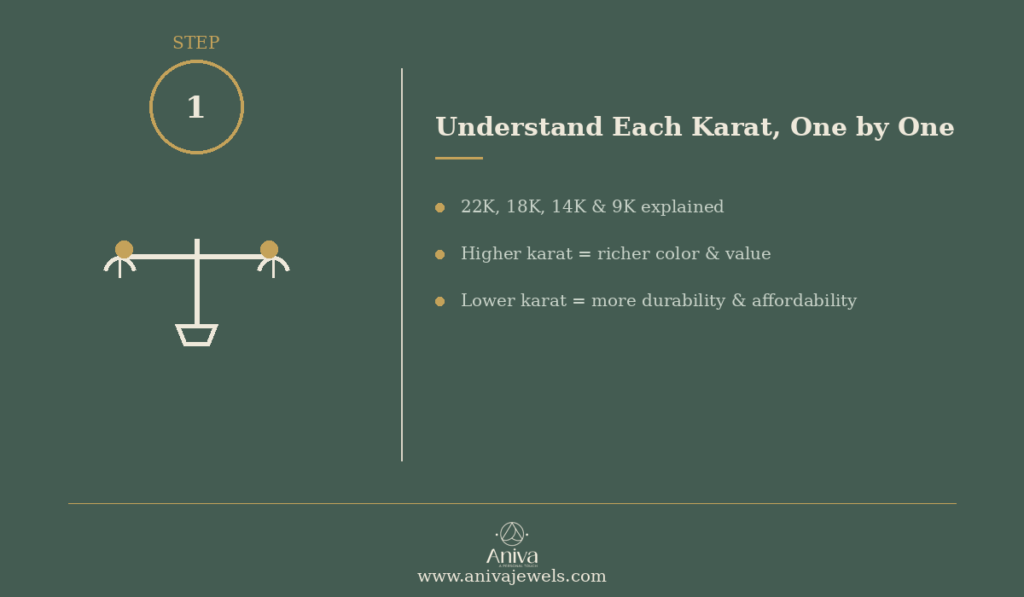
If you remember just one thing from this section: higher karat = richer gold color and value, lower karat = more durability and affordability.
Step 2: Which Karat Is Best for Diamond Jewellery Specifically?
This is where most guides stop short—so let’s be specific.
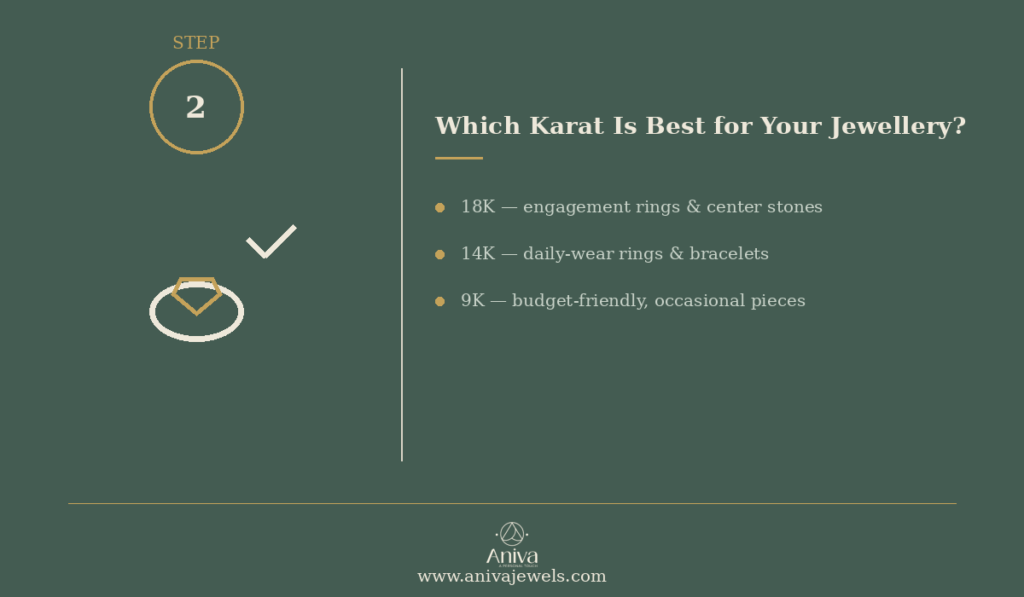
For engagement rings and pieces with larger diamonds: → 18K is the global standard. It offers the best balance of durability and gold richness to hold a center stone securely for years. Explore our Diamond Rings collection crafted in 18K gold.
For earrings, pendants, and lighter everyday pieces: → 14K or 18K both work well. 14K if you want extra durability for daily wear. Browse our Diamond Earrings and Pendants for both options.
For bangles, bracelets, and pieces that take daily impact: → 14K is often the smarter choice—more resistant to dents and scratches.
For budget-conscious, trend-led pieces (worn occasionally): → 9K can work, especially for smaller diamonds or accent stones.
There’s no universally “best” karat—only what’s best for how and how often you’ll wear the piece.
Step 3: How Karat Affects Price
This is usually the deciding factor for most buyers.
- Higher karat = more actual gold = higher price
- Lower karat = more alloy = lower price
- Diamond cost stays the same regardless of karat—only the metal cost changes
So if you’re trying to fit a bigger diamond into your budget, choosing a lower karat gold (like 14K instead of 18K) can free up budget for the stone itself, without compromising on the diamond quality.
Step 4: Always Check the BIS Hallmark on Gold Jewellery
Whatever karat you choose, never skip this step.
Look for:
- BIS Hallmark (mandatory in India for gold purity certification)
- Karat stamp (375 for 9K, 585 for 14K, 750 for 18K, 916 for 22K)
- Jeweller’s certification along with the hallmark
A hallmark isn’t optional trust—it’s your legal proof of what you’re actually paying for. Buying hallmarked gold jewellery in India protects you from underweight or under-karated pieces. Every piece from Aniva Jewels comes with certified diamonds and BIS hallmarked gold, so you never have to second-guess what you’re buying.
Step 5: Common Myths About Gold Karat, Cleared Up
“Higher karat is always better.” Not for diamond jewellery. Too high a karat (like 22K) can actually be too soft to hold stones securely.
“Lower karat means fake gold.” False. 9K and 14K are real, hallmarked gold—just with a different purity percentage, not fake in any way.
“White gold and platinum are the same.” No. White gold is yellow gold alloyed and rhodium-plated to look white. Platinum is a separate, naturally white metal—denser and more expensive.
Final Thoughts
Choosing gold karat isn’t about picking the “best” one—it’s about picking the right one for your piece, your lifestyle, and your budget.
An 18K diamond ring for daily wear. A 14K bracelet that can take a few knocks. A 9K pendant for someone just starting their diamond collection.
Once you understand what each karat actually offers, you stop guessing—
and start choosing with confidence.
FAQs
1. Which gold karat is best for diamond rings?
18K gold is the most recommended for diamond rings—it’s strong enough to hold the diamond securely while maintaining rich gold content.
2. Is 9K gold good quality?
Yes, 9K gold is genuine, hallmarked gold. It has lower gold content (37.5%) but is more durable and affordable, making it suitable for budget-friendly and everyday pieces.
3. What is the difference between 14K and 18K gold?
14K gold contains 58.3% pure gold and is more durable, while 18K gold contains 75% pure gold, offering a richer color but slightly less resistance to scratches and dents.
4. Can 22K gold be used for diamond jewellery?
It’s uncommon. 22K gold is quite soft, making it less ideal for securely holding diamonds. It’s more commonly used for plain gold jewellery.
5. How do I verify gold purity before buying?
Always check for the BIS hallmark and the karat stamp (375, 585, 750, or 916) on the piece, along with certification from the jeweller—this is the only reliable way to confirm gold purity percentage before you pay.